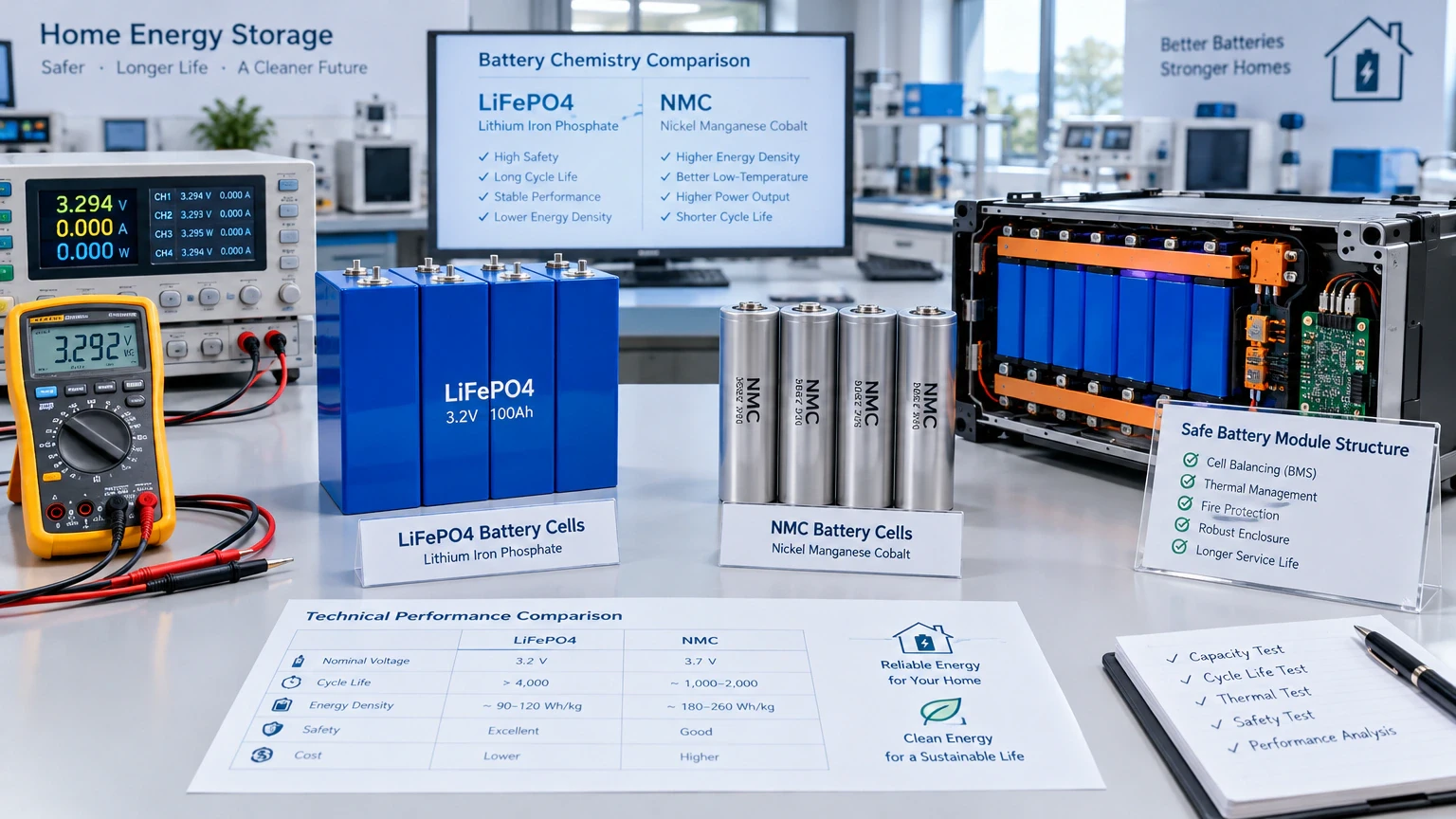
TECHNICAL COMPARISON GUIDE
LiFePO4 vs Ternary Lithium: Choosing the Right Chemistry for Home Energy Storage
When evaluating residential battery backup, the debate between Lithium Iron Phosphate (LiFePO4) and Ternary Lithium (NMC/NCA) determines your home's safety margin, lifetime cycle count, and true cost per kilowatt-hour.
For residential energy storage systems, Lithium Iron Phosphate (LiFePO4) is the proven superior chemistry over Ternary Lithium (NMC). While ternary cells excel in high energy density for electric vehicles, LiFePO4 provides uncompromised thermal safety with a runaway threshold above 270°C, zero oxygen release during thermal stress, and an industry-leading lifespan exceeding 6,000 cycles. Over a 10-year operational horizon, LiFePO4 reduces your cost per usable cycle by over 60% compared to ternary alternatives.
Every YDPOWER Mini ESS system—from compact 800Wh units to wall-mounted 4000Wh systems—is engineered around dedicated automotive-grade LiFePO4 cells. Below is an engineering-driven breakdown comparing both technologies across safety, lifespan, thermal tolerance, and domestic total cost of ownership.
SECTION 01 · CORE CHEMISTRY
Chemical & Structural Differences: Olivine vs Layered Oxide
The performance differences between LiFePO4 and Ternary lithium (Nickel Manganese Cobalt, or NMC) stem directly from their crystal lattice structures:
- LiFePO4 (LFP): Utilizes an olivine crystalline structure. The phosphorus-oxygen covalent bond (P-O) is extraordinarily strong and structurally rigid. Under mechanical penetration, overvoltage, or short-circuit stress, the oxygen atoms remain tightly locked in the phosphate group, preventing oxygen gas liberation.
- Ternary Lithium (NMC/NCA): Features a layered transition-metal oxide structure. While this allows higher packing density and faster lithium-ion mobility, the nickel-oxygen bonds are thermally unstable. When overheated or overcharged, the layered lattice collapses, releasing volatile oxygen internally and precipitating exothermic chain reactions.
In stationary residential Mini ESS systems, volumetric compactness takes second place to absolute domestic stability. A home battery operates inside living rooms, corridors, or utility rooms where non-combustion reliability is paramount.
SECTION 02 · SAFETY METRICS
Thermal Stability & Safety Margins Inside the Home
Home energy storage safety is defined by the thermal runaway threshold—the point where an internal failure produces self-sustaining heat faster than dissipation can cool it down.
| Safety Metric | LiFePO4 (LFP) | Ternary Lithium (NMC) | Impact on Home Users |
|---|---|---|---|
| Thermal Runaway Temperature | 270°C – 300°C | 150°C – 210°C | LFP tolerates substantially higher localized heating before reacting. |
| Oxygen Liberation | None (P-O bond intact) | Yes (Internal oxygen release) | NMC feeds internal fires even without external atmospheric oxygen. |
| Overcharge Tolerance | High stability margin | Sensitive to BMS disconnect latency | LFP offers wider tolerance against grid voltage spikes or solar surge. |
| Nail Penetration Behavior | Smoke / Slight heating, no open flame | Violent combustion / Deflagration | Crucial for accidental physical drops or puncture resistance. |
Because YDPOWER Mini ESS models comply with rigorous UN38.3, MSDS and verified compliance standards, integrating LiFePO4 cells ensures that multi-layer hardware protection is backed by inherently safe cell physics, verified through our factory quality control processes.
SECTION 03 · FINANCIAL RETURN
Cycle Life and 10-Year True Cost per Cycle
While ternary lithium packs sometimes exhibit slightly lower upfront purchase costs per raw watt-hour, their rapid degradation under daily deep cycling makes them drastically more expensive over their working lifespan.
Consider a typical household facing daily or alternate-day outages, executing 1 full cycle per day (365 cycles annually):
- Standard Ternary Battery: Rated at 800 to 1,200 cycles at 80% Depth of Discharge (DoD). Within 2.5 to 3 years, the battery capacity drops below 70%, demanding complete unit replacement.
- YDPOWER LiFePO4 Mini ESS: Rated at ≥6,000 cycles at 80% DoD. Even after 10 years of relentless daily cycling (3,650 cycles), the system retains over 80% of its initial energy reserve.
When calculating Levelized Cost of Storage (LCOS): A $1,000 2kWh LiFePO4 unit delivering 6,000 cycles costs approximately $0.08 per cycled kWh. Conversely, an $800 2kWh ternary battery delivering only 1,000 cycles yields a cost of $0.40 per cycled kWh—making ternary five times more costly across a decade of use.
SECTION 04 · REAL-WORLD CLIMATES
Performance Across Tropical and High-Temperature Climates
In developing power markets across West Africa (such as Nigeria) and Southeast Asia (such as the Philippines and Indonesia), ambient room temperatures regularly exceed 35°C to 40°C during dry seasons. Operating a lithium battery at elevated temperatures accelerates electrolyte breakdown and solid electrolyte interphase (SEI) thickening.
Ternary batteries suffer severe exponential life degradation when operating above 35°C. In contrast, the chemical bonding in LiFePO4 preserves structural integrity at continuous operating temperatures up to 55°C, ensuring consistent power delivery for fans, lighting, and communication devices without premature cell swelling.
Discover how our systems perform in different form factors, including movable floor-standing systems and wall-mounted home units designed with high-dissipation metal enclosures.
SECTION 05 · BUYER'S CHECKLIST
Decision Framework: Matching Chemistry to Your Application
Before purchasing or procuring energy storage hardware, compare the requirements of your use case:
- Choose LiFePO4 if: The unit will be installed inside a home, school, clinic, or business where human safety is non-negotiable; you need 5 to 10+ years of daily cycling; or the local climate experiences sustained tropical heat.
- Choose Ternary (NMC) only if: Gravimetric weight is the single determining metric (such as lightweight hiking gear or high-speed racing drones) where battery life is discarded after 1-2 seasons.
To evaluate capacity needs for your specific appliances, read our detailed guide on how to choose a Mini ESS for home backup or review the full Mini ESS technical comparison matrix.
SECTION 06 · FAQ
Frequently Asked Questions
Why is LiFePO4 preferred over ternary NMC for residential energy storage?
LiFePO4 features an olivine crystal structure with strong P-O chemical bonds, elevating its thermal runaway threshold to 270°C–300°C without releasing oxygen. This chemical stability makes it substantially safer for indoor domestic installations compared to NMC ternary cells.
How do cycle lives compare between LiFePO4 and ternary lithium batteries?
Grade-A LiFePO4 energy storage cells typically deliver ≥6,000 cycles at 80% Depth of Discharge (DoD), corresponding to 10 to 15 years of daily backup cycles. Ternary lithium cells typically degrade to 80% original capacity after 800 to 1,500 cycles under comparable discharge conditions.
Does the heavier weight of LiFePO4 matter for home energy storage systems?
For stationary and residential backup applications, safety, fire risk prevention, and cycle longevity are far more critical than extreme gravimetric energy density. While NMC offers higher volumetric energy density for electric vehicles, residential Mini ESS systems benefit significantly from LFP's durability.
Can LiFePO4 batteries operate reliably in high-temperature tropical climates?
Yes. LiFePO4 demonstrates superior thermal stability in tropical and sub-tropical environments such as Nigeria and the Philippines, handling ambient temperatures up to 50°C–55°C without the rapid capacity fade and thermal hazard risks associated with ternary chemistries.